

I’ve been watching engineering teams hit the same wall over and over.
They scale from 50 to 200 engineers. Deployment velocity increases. Code ships multiple times daily. And then QA becomes the bottleneck.
The math is brutal. Either you hire QA engineers proportionally (expensive, 3-month onboarding, $80-120K annually) or you accept longer release cycles. Neither option is good when your competitors are shipping faster.
Most teams respond by bolting test automation onto their CI/CD pipeline. They write Selenium scripts. They parallelize execution. They optimize for speed.
But they’re solving the wrong problem.
The Automation Trap
Here’s what I mean.
Traditional test automation (Selenium, Cypress, Playwright) requires humans to write test cases. Every new feature needs new test scripts. Every refactor breaks CSS selectors and DOM queries.
You’re not actually reducing QA workload. You’re just shifting it from manual clicking to test script maintenance.
The maintenance debt scales linearly with your codebase. As you grow from 50 to 500 engineers, your test automation suite becomes harder to maintain than your actual product.
I was talking to the team at Islands last month. They manage dev work across 8-15 simultaneous client projects. They were spending 40% of their QA time just keeping test scripts updated after routine refactors. Not finding bugs. Not improving quality. Just fixing broken selectors.
That’s the trap.
What Autonomous Testing Actually Means
72.3% of teams are exploring AI-driven testing workflows. But most implementations still require humans to define what to test.
True autonomous testing reads design specs and commit messages to generate test cases without human input.
The architectural difference matters.
Automated testing: humans define test cases, machines execute them Autonomous testing: machines define AND execute test cases
Here’s the pattern that works:
The Architecture Pattern
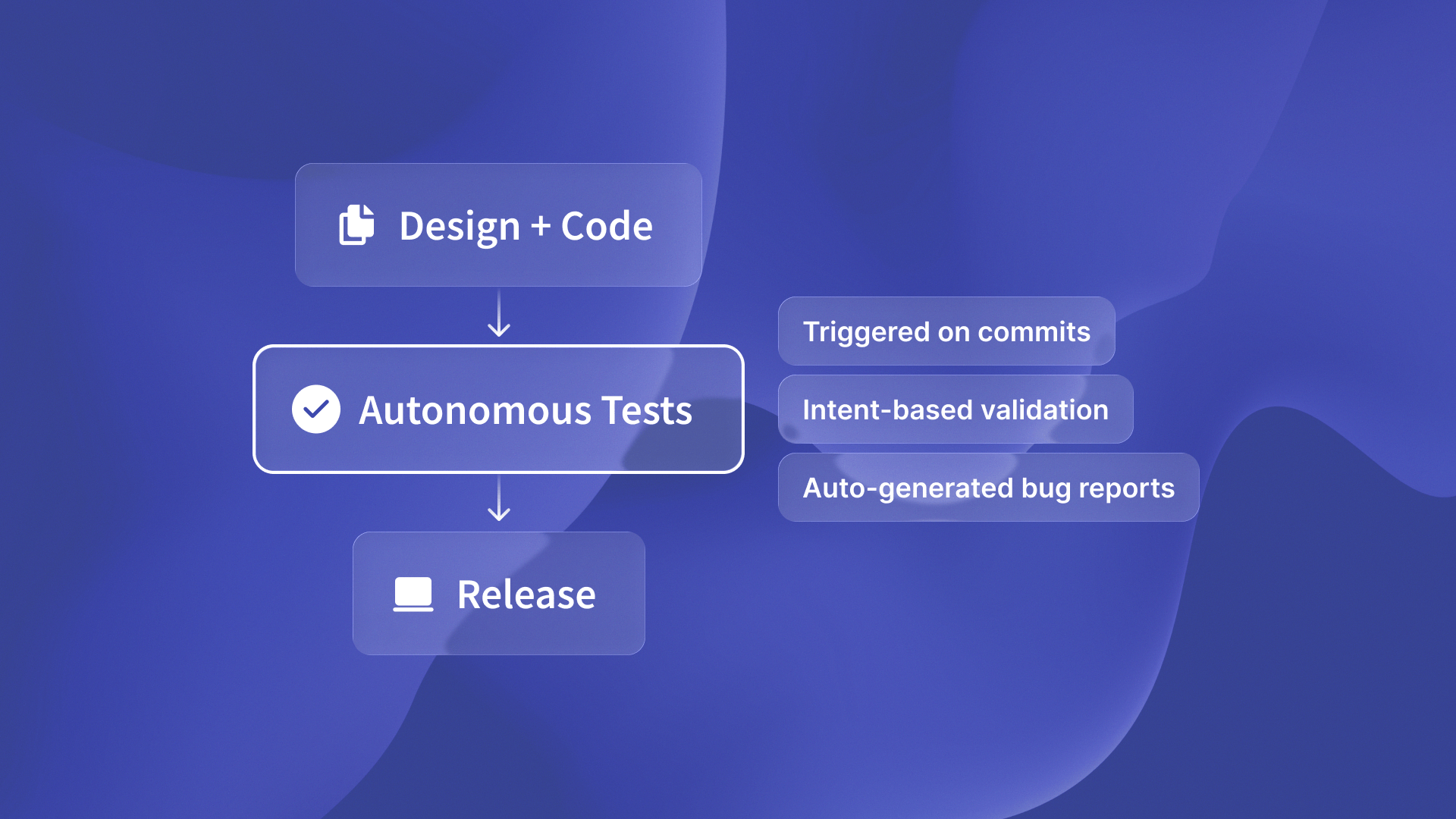
Trigger on design commits. When designers update Figma specs, that triggers test generation. The system reads the design changes, understands intended behavior, and generates relevant test cases automatically.
Execute in parallel on every push. Every GitHub commit triggers a full regression suite. No waiting for nightly builds. No batching deployments.
Auto-create comprehensive bug tickets. When tests fail, the system posts detailed tickets directly to Jira or Linear. Network logs, status codes, broken endpoints, reproduction steps, environment context.
Last week I saw this play out at QA flow. They built their autonomous testing platform around this exact pattern. Figma webhooks trigger test generation. Tests execute on every commit. Bug tickets appear in Linear with full network traces.
Their QA cycle time dropped from 2 weeks to 3 days.
Why Intent-Based Testing Survives Refactors
The key insight: test behavior, not implementation.
Selenium tests break when you change a CSS class. Button IDs change. DOM structure shifts. Every refactor requires test updates.
Intent-based testing validates behavior from design specs. It asks: does the login flow work? Not: does button#submit-btn exist?
When developers refactor code, behavior usually stays the same. The login flow still needs to authenticate users. The payment form still needs to process transactions.
Tests that validate behavior survive refactors. Tests that query DOM elements don’t.
The DevOps Velocity Problem
DevOps adoption jumped from 16.9% in 2022 to 51.8% in 2024. Teams are shipping code multiple times daily.
But QA workflows haven’t evolved to match that velocity.
Traditional QA operates in batches. Write test cases. Execute manually. Report bugs. Wait for fixes. Regression test.
That cycle takes 2 weeks minimum. It doesn’t work when developers push code 10 times per day.
The constraint becomes obvious at Series B-C scale. You either hire QA proportionally (which is expensive and slow) or you slow down releases (which creates competitive risk).
Autonomous CI/CD testing breaks this trade-off.
The Debugging Time Factor
67% of developers spend more time debugging AI-generated code.
This makes comprehensive bug tickets critical.
When a test fails, developers need context. What request failed? What was the response? What environment settings matter?
Most automated testing tools just report “test failed.” Then QA and developers spend hours in back-and-forth trying to reproduce the issue.
I noticed something interesting at Timecapsule recently. They track time spent on every task with real-time profitability monitoring. They discovered their developers were spending 6 hours per week just gathering context on failed test reports.
That’s 15% of development time lost to communication overhead.
Autonomous testing fixes this by capturing full context automatically. Network logs. API responses. Request headers. Screenshots. Video recordings.
Everything a developer needs to fix the bug, posted directly to the ticket.
What This Means for QA Teams
Here’s what I tell engineering leaders.
Autonomous testing isn’t about replacing QA engineers. It’s about redeploying them from repetitive regression to high-value exploratory testing.
Your QA team stops clicking through login flows for the 847th time. They start finding critical edge cases that autonomous systems miss.
You get faster releases AND better quality.
The teams that architect autonomous testing into CI/CD now will have a compounding advantage. Faster release cycles. Better quality. QA teams focused on finding what matters instead of regression testing.
For more on how autonomous testing changes QA roles, I wrote about this in detail here: How QA flow helps QA engineers
The Implementation Pattern
Connect design tools. Figma webhooks or equivalent for your design platform
Hook into version control. GitHub/GitLab commit hooks that trigger on every push
Generate tests autonomously. Read specs and commit messages to understand intended behavior
Execute in parallel. Run full regression suite on every commit without slowing deployments
Auto-post comprehensive tickets. Network logs, reproduction steps, environment context directly to Jira/Linear
The result: sub-3-day QA cycles without proportional hiring.
You scale development velocity without scaling QA headcount.
That’s the architecture that works.