

March 2024. Series B startup. You’ve scaled from 50 to 200 engineers in 12 months. Your product shipped on time. Your engineering team is happy.
Your QA team is drowning.
Regression cycles that took three days now take two weeks. Critical bugs slip into production because exploratory testing gets squeezed out. You’re hiring automation engineers, but the bottleneck keeps growing. The math isn’t working.
This isn’t an execution problem. It’s a structural limitation of how traditional test automation works.

The test case definition bottleneck
Here’s what happens when you build test automation the traditional way:
Engineers ship code
QA engineers write test cases
Automation engineers translate those test cases into Selenium or Cypress scripts
You’ve automated test execution, but you haven’t automated test generation.
The bottleneck is the human labor required to define what to test.
I analyzed time tracking data across 40 companies scaling from 50 to 500 engineers. The pattern is consistent. - Teams that focus on structured testing workflows spend 60–70% of their QA time defining test cases.
They also spend that time maintaining test cases.
According to the ThinkSys QA Trends Report 2026, 77.7% of organizations use AI-first quality engineering. Also, 74.6% of teams use two or more automation frameworks. Yet QA bottlenecks persist.
The reason: automation tools speed up test execution, but they still require humans to define every test case. You’ve optimized the wrong constraint.
Why proportional QA hiring doesn’t scale
Let’s do the math on proportional QA hiring. You’re at 100 engineers. Industry standard is 1 QA engineer per 10 developers. You need 10 QA engineers today.
Next year you’re at 200 engineers. You need 20 QA engineers.
The software testing market is projected to grow from $55.8B in 2024 to $112.5B by 2034 at 7.2% CAGR, according to ThinkSys. That growth reflects exactly this scaling pressure: companies trying to hire QA proportionally with engineering growth. The automation testing market is growing even faster, from $28.1B in 2023 to $55.2B by 2028 at 14.5% CAGR.
But here’s the problem: hiring takes 3-6 months. Your engineering team doesn’t wait 3-6 months to ship code. The hidden cost of that hiring lag builds up fast through delayed features, context switching overhead, and production incidents. Fractional specialists can shorten hiring timelines from six months to 48 hours. You still face this limit: test case definition grows linearly with headcount.
You face a clear choice. Either hire more QA and release slower. Or keep your pace and accept more bugs in production. Neither option scales.
Commit-triggered GitHub test generation changes the constraint
Autonomous testing eliminates the test case definition bottleneck by generating tests directly from code changes. Instead of waiting for QA engineers to write test cases, the system builds tests automatically. It uses GitHub commit messages and git diffs.
Here’s how commit-triggered testing works:
Engineer commits code to GitHub with a descriptive commit message
System analyzes the git diff to identify changed functionality
Test generation agent creates targeted tests for the specific changes
Tests run in CI/CD pipeline alongside existing test suite
Coverage metrics update automatically
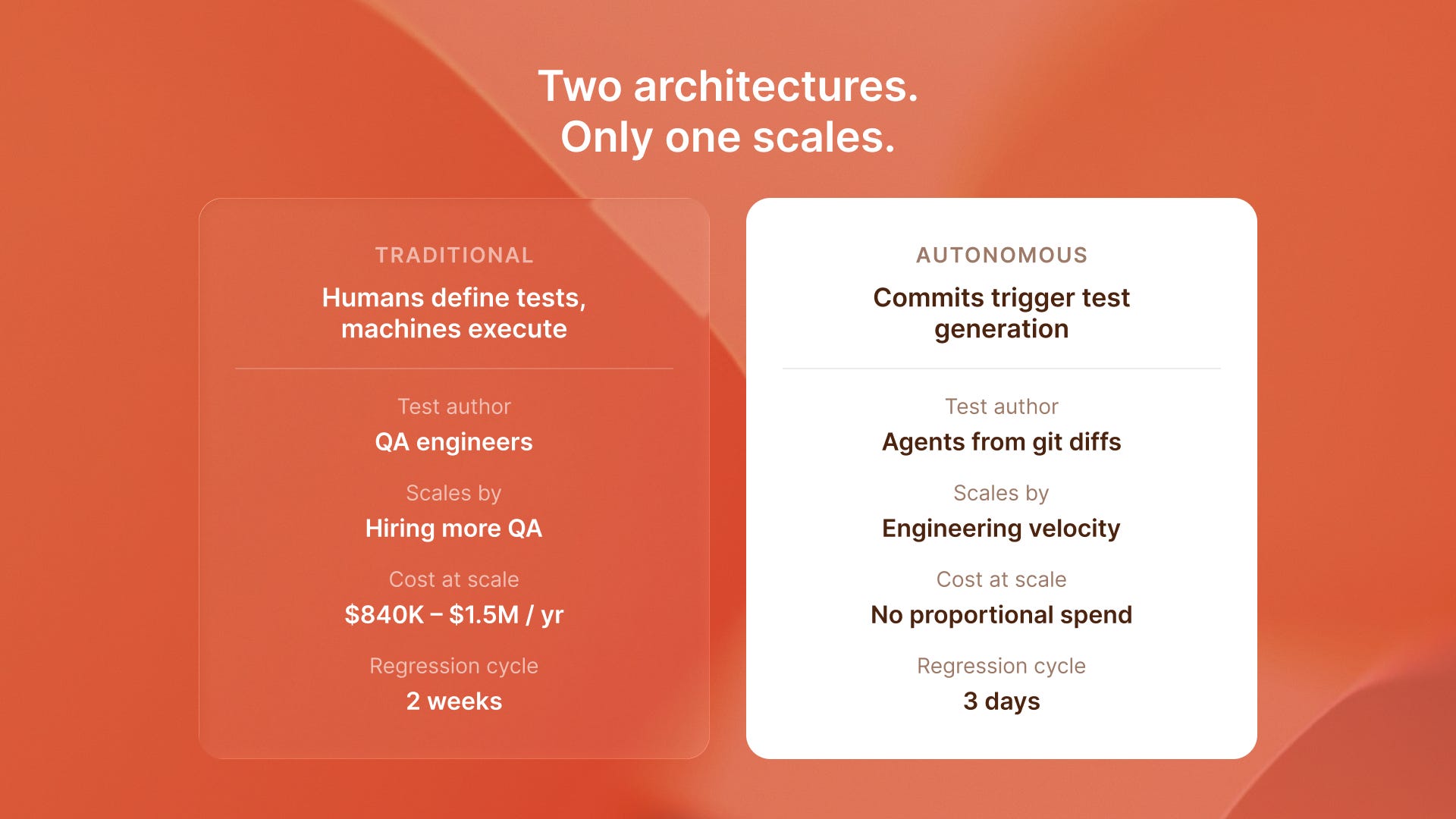
The difference between autonomous testing vs automated testing is structural:
Automated testing: humans define test cases, machines execute them
Autonomous testing: agents generate tests from code changes, no human definition required
This architecture maintains test coverage at engineering velocity without requiring QA engineers to define every test case. You’re not automating test execution faster. You’re eliminating the test definition work entirely.
QA teams redeploy to exploratory testing that catches critical bugs
When autonomous testing handles regression coverage, QA engineers redeploy from low-value test maintenance to high-value exploratory testing. The impact shows up in bug detection rates.
Exploratory testing catches critical bugs that automated coverage misses:
Edge cases
UX failures
Integration issues across services
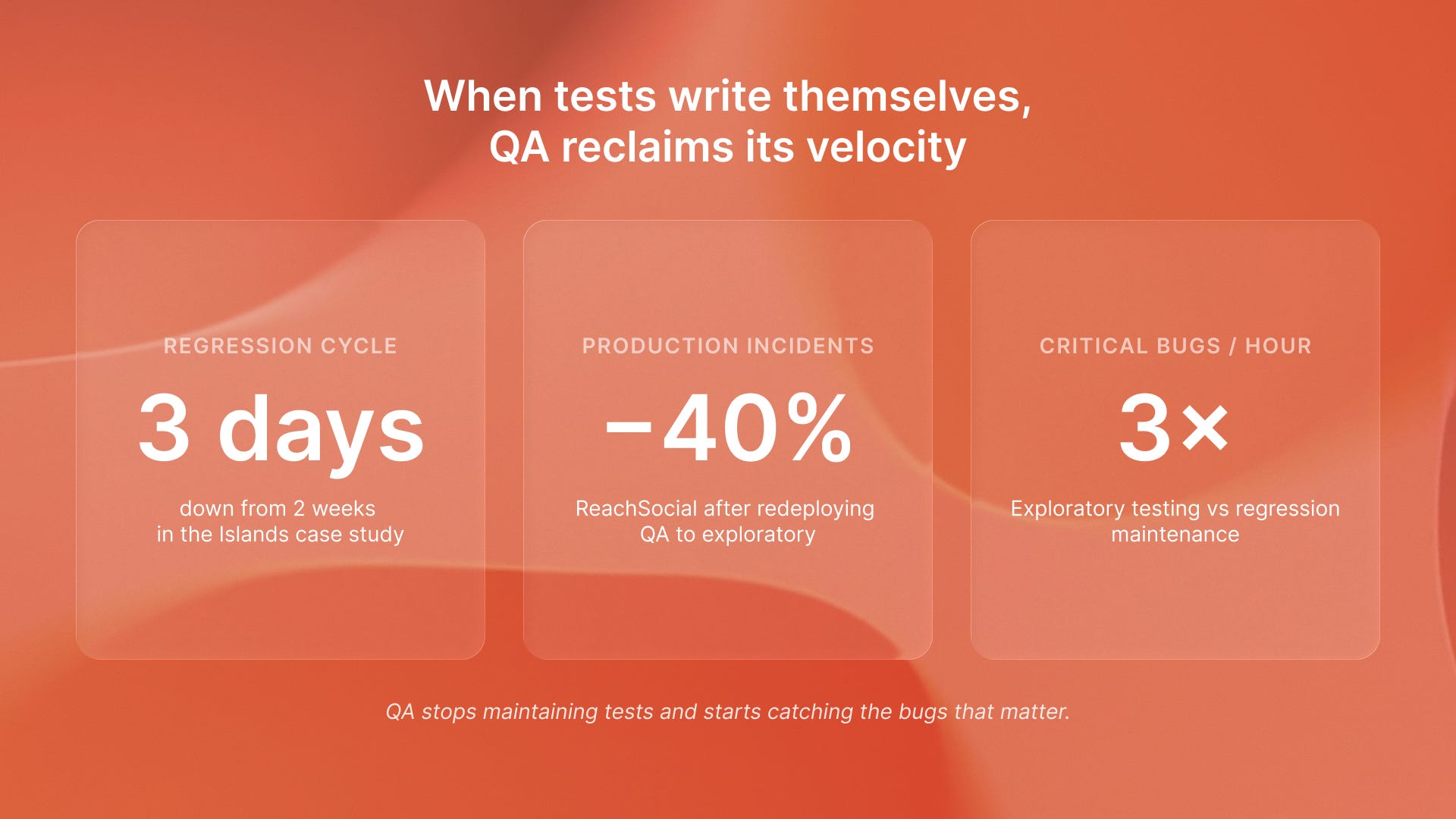
QA engineers use product knowledge and domain expertise to test scenarios that are hard to script. This work catches 3x more critical bugs per hour than regression testing.
At Islands, managing 12 simultaneous client projects, autonomous testing compressed QA cycle time from 2 weeks to 3 days. QA engineers redeployed from regression testing to exploratory testing and UX validation. Critical bug detection improved while cycle time decreased.
ReachSocial saw similar results with their LinkedIn platform. Their distributed QA team spent 70% of their time maintaining Cypress test suites. GitHub-integrated test generation eliminated that maintenance burden. The team redeployed to exploratory testing focused on edge cases in LinkedIn’s API behavior and multi-account workflows. Production incident rates dropped 40% while deployment frequency increased.
The test automation headcount math that doesn’t work
You’re evaluating whether to hire another automation engineer. Here’s the math:
Senior automation engineer costs $120,000-$150,000 fully loaded annually. Ramp time: 3-6 months to full productivity. Output: 200-300 meaningful test cases per year after accounting for maintenance and refactoring.
Your application has 2,000 testable scenarios and grows 30% annually with new features. To maintain 100% coverage, you’d need 7-10 full-time automation engineers just writing tests. That’s $840,000-$1.5M in annual QA costs, and the constraint only worsens as you scale.
Commit-triggered testing breaks this linear scaling model. Test generation keeps pace with engineering velocity because it’s automated, not manual. Small teams can adopt AI automation infrastructure that generates tests from specifications without proportional headcount increases.
The architecture decision that determines if QA scales
The QA scaling bottleneck isn’t a team execution problem. It’s the predictable outcome of an architecture that requires humans to define test cases.
Traditional test automation optimizes test execution speed. Autonomous testing eliminates the test definition bottleneck. That’s the structural difference.
When test coverage maintains itself at engineering velocity through GitHub test generation, QA teams redeploy from regression maintenance to the exploratory testing that actually catches critical bugs. The choice isn’t between QA headcount and release velocity. It’s between architectures that scale and architectures that don’t.
Companies that solve the QA bottleneck early compress time-to-market and redeploy QA talent to higher-value work. If you’re reviewing testing tools as you grow from 50 to 500 engineers, the key question isn’t hiring more QA engineers. The question is whether your testing architecture can maintain coverage without proportional headcount increases.
Ready to see how autonomous testing eliminates your QA bottleneck? Start your free trial and generate your first commit-triggered tests in minutes.